Architect Jindřich Freiwald and the architectural firm he ran together with Jaroslav Böhm worked on a great number of projects built in the Czech countryside. Freiwald graduated from a technical college in Prague. His university studies were interrupted by First World War I: at first, he studied in 1913–1915, and after he returned from military service, he studied at Jan Kotěra’s special architectural school at the Academy of Fine Arts in 1917–1918 [1]. Kotěra considered Freiwald one of his most talented students and recommended him to Mayor František Ulrich as a member of the new generation of architects to work on the development of Hradec Králové. Already before World War I, Freiwald designed the façade of the Start Hotel and an unbuilt tenement house. After the war, he worked for construction cooperatives, banks and private owners in Hradec Králové.
But he did not work on more important projects until after World War I. In 1919, he designed terraced houses for the Ořechovka villa colony at 288–299 and 337–340 Klidná Street and at 264–271 a 341–350 Dělostřelecká Street. In Prague, he designed the cooperative colony in Na Perníkářce Street; in Hradec Králové, cooperative apartment houses in Čelakovského Street (1920). In the early 1920s, Freiwald collaborated with Jaroslav Böhm, focusing primarily on developing ideal layouts and decorative forms of affordable housing and designing ideal duplexes and fouplexes (for the city of Opava) [2]. Freiwald and Böhm created an original synthesis of strictly modernist features promoted by Kotěra’s school before WWI and features borrowed from traditional architecture, local regional sources and historical architecture. Examples include detached and terraced houses in Kolín (no. 19–23), Sušice (the “Benátky” quarter of 1924), Duchcov (1922–1924), and submissions to competitions for type houses in Spořilov (1925) and Mělník (1927), all published in various versions in the representative publication Naše stavby (Our Buildings) [3]. Freiwald also designed bourgeois villas, for example, manufacturer Ganz’s villa in Pardubice (9 Jahnova Street, 1921) or Schwarzkopf’s villa in Sušice (154/II T. G. Masaryka Street, 1925–1930). The vila of factory owner Nejedlý and his family in Kukleny near Hradec Králové (designed between 1923 and 1924) was never built.
During the late 1920, Freiwald and Böhm’s studio began to focus on designing major public buildings for small towns: savings banks and other banks, theatres, churches, and schools. Working on these designs, Freiwald proved to be a sufficiently variable architect who was able to meet both conservative and progressive demands of the owners. His probably most conservative project was the theatre in Hronov (1927–1930) with an aedicula façade and a classically segmented architrave. The theatres in Chrudim (1931–1934) and Kolín (1937–1939) combined undetailed lesene monumental morhphology with the modernist grammar (alternating smooth and brickwork surfaces). Like the savings banks, the theatre buildings included a wide range of forms: from the decorative (Kolín, 1923–1925) and monumental ones (Nové Město nad Metují, 1929–1930, and Hronov, 1936–1939) to the predominantly modern ones (Libochovcie, 1934; Polička, 1936–1937, and Mělník, 1937–1938). Freiwald and Böhm used modern monumental forms also in the design of the trade school in Sušice (1929–1930). Progressive avant-garde forms, reminiscent of contemporary sacral projects designed by Josef Gočár and Pavel Janák, were used in the design of the Czechoslovak Hussite Church in Nové Město nad Metují (1933–1934).
During WWII, Jindřich Freiwald did not work on any designs but he wrote a typological guide to modern “homes from homes” – cottages and weekend houses in the country and countryside, published posthumously in 1947 [4]. Freiwald died during the liberation of Prague on 8 May of 1945.
His work was probably best described by architectural historian Martin Horáček. To him, Freiwald and Böhm’s designs “were able to include any style, from geometric Art Nouveau, rondocubism and functionalism through the New Tradition to regional vernacular architecture. The studio represented a decent standard; their family houses and buildings amenities became part of the inventory of many small Czech towns” [5].
LZL
Notes
[1] Comp. Ladislav Zikmund-Lender, Struktura města v zeleni: Moderní architektura v Hradci Králové, Hradec Králové 2017, p. 121
[2] Comp. Pavel Vlček (ed.), Encyklopedie architektů, stavitelů, zedníků a kameníků v Čechách, Prague 2004, p. 185
[3] Jindřich Freiwald; Jaroslav Böhm, Naše stavby, Prague 1924.
[4] Jindřich Freiwald, Chaty, sruby, domky: zásady rekreačního bydlení, Prague 1947
[5] Martin Horáček, Za krásnější svět: tradicionalismus v architektuře 20. a 21. století, Brno 2013, pp. 236–237
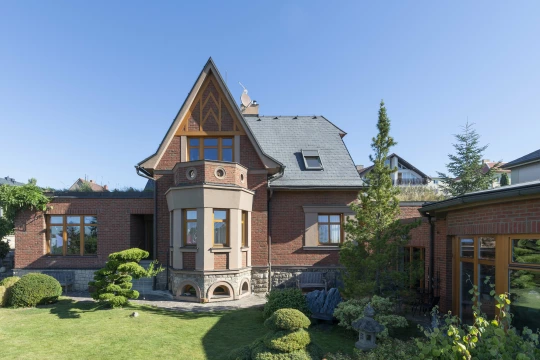
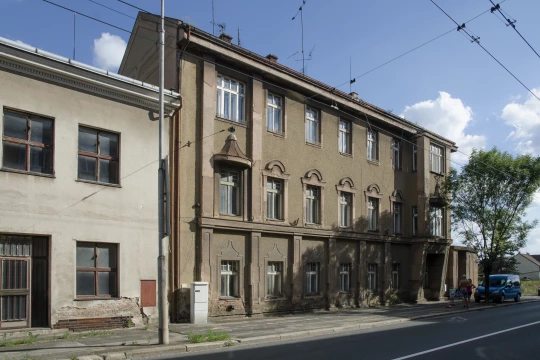 Josef Seyfried’s Multi-Purpose Factory BuildingKrálovéhradecký architektonický manuál
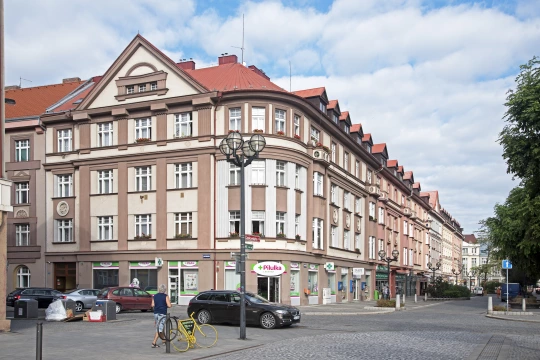 Tenement HousesKrálovéhradecký architektonický manuál
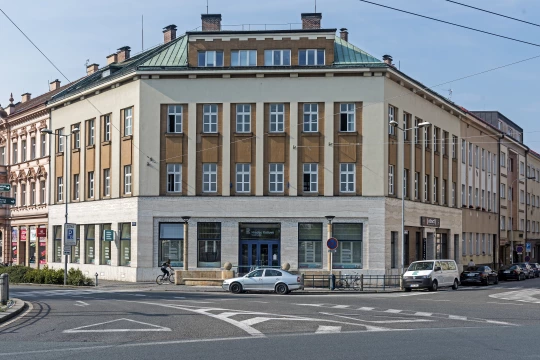 The Agrarian BankKrálovéhradecký architektonický manuál
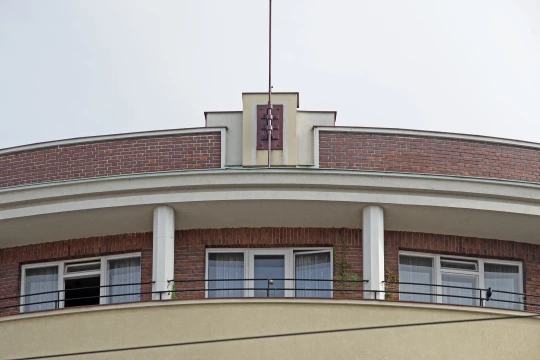 The First Czech Mutual Insurance CompanyKrálovéhradecký architektonický manuál
 The Start (Paříž) HotelKrálovéhradecký architektonický manuál