František Grossmann was born on 3 August 1876 in Pustějov in Silesia into a Czech Catholic family as one of eight children. His father was a cottager who also earned a living as a bricklaying foreman, and his mother Anna also came from a cottager’s family. Despite being born into a Czech environment, he gravitated towards the German environment and used the German form of his first name. After completing primary school in Pustějov, he attended the master school at the Brno Technical School and then completed bricklaying apprenticeship with his father. Although he referred to himself as an architect, he had no academic training in the field.
Until 1906, Grossmann worked as an independent builder in Frýdek, before moving to the expanding industrial city of Ostrava, which offered greater career opportunities. There, in 1906, he met the aspiring architect František Fiala, a pupil of the eminent Viennese architect Otto Wagner, and together they founded the company Grossmann & Fiala, which held a licence for designing and carrying out constructions. While Fiala served as the creative architect and handled the design work, Grossmann was responsible for the operational and construction aspects. The company also owned a brickyard in Moravská Ostrava on Cihelní Street (now Hornopolní Street) and a carpentry shop with a workers’ apartment, coachman’s apartment, a stable, a joinery and storage facilities on Dr Richter Street (now Na Zapadlém Street).
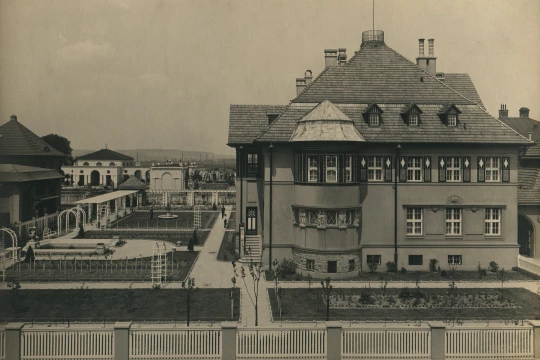
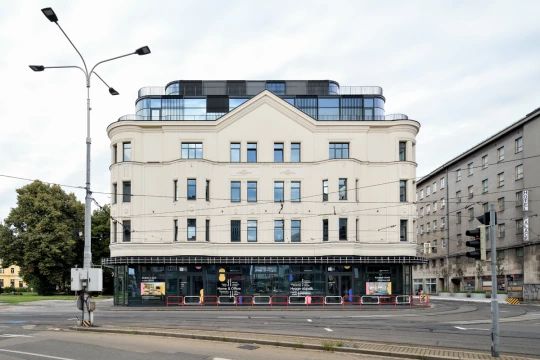
Grossmann married late in life; in March 1924 he wed Otilie Lihotzká. The marriage remained childless. The couple lived in the villa designed by Grossmann on 28. října Street in Moravská Ostrava.
The firm Grossmann & Fiala realised a large number of constructions in the Ostrava region, either based on their own designs or those of others. These include the churches in Mariánské Hory and Hrabůvka, the house for Catholic Journeymen in Moravská Ostrava, and the sanatorium for Dr Klein. The firm also executed industrial projects, such as the waterworks complex in Nová Ves, the reconstruction of the Hermenegild (later Zárubek) Mine in Slezská Ostrava, and the administrative building of the Petr Cingr (now Michal) Mine in Michálkovice. In the wider region, its realisations included the German middle school in Kopřivnice and the church in Háj ve Slezsku–Chabičov.
Around 1918, František Fiala left the company for unknown reasons, and Grossmann began collaborating with his younger brother Richard, who took charge of construction management and securing contracts. The firm then operated mainly in the wider Ostrava area, including Bílovec, Studénka, Kunčice, and Pustějov. At the turn of the 1920s and 1930s, the company encountered serious financial difficulties, caused mainly by the economic crisis and by the large number of clients who owed Grossmann money. He often got into disputes with them regarding the quality of the work delivered. Grossmann also made unwise investments, and by the early 1930s his debts had reached five million crowns, while he held claims amounting to 2.5 million. The firm faced repeated executions, and in November 1933 Grossmann and his wife committed suicide.
Although Grossmann referred to himself as an architect, very few designs can be attributed to him personally. These are mainly constructions realised after Fiala’s departure from the firm in the 1920s and early 1930s. Those that are known are characterised by an eclectic style incorporating elements of late Art Nouveau, Neo-Biedermeier and decorativism (his own villa with an office building), and sometimes elements of folk and mountain architecture (Rašín Chalet, the Wallachian Summer Restaurant in Štramberk). However, most of them were likely conceived as building contractor-style objects without significant architectural ambitions or style.
Other Selected Works
Completed projects:
waterworks complex, Ostrava–Nová Ves, 1904–1908 (construction executed to the design of Karl Schwager)
Church of Our Lady Queen, Stojanovo Square, Ostrava–Mariánské Hory, 1907–1908 (construction executed to the design of Otokar Bém)
Church of Our Lady of the Rosary, Metodějská Street, Ostrava–Hrabůvka, 1909–1910 (construction executed to the design of Josef Pokorný)
Dr Leopold Klein Sanatorium, Hornopolní Street 1392/13, Ostrava–Moravská Ostrava, 1909–1911
house for Catholic Journeymen, Přívozská Street 135/8, Ostrava–Moravská Ostrava, 1910–1911 (construction executed to the design of František Fiala)
reconstruction of the Hermenegild (Zárubek) Mine, Podzámčí, Ostrava–Slezská Ostrava, 1913–1914, demolished 1998 (construction executed to the design of František Fiala)
administrative building of the Petr Cingr (Michal) Mine, Československé armády Street 413/95, Ostrava–Michálkovice, 1913–1915 (construction executed to the design of František Fiala)
own residential house with an office building, třída 28. října 1674/131, Na Zapadlém 261/16, 2445/18, Ostrava–Moravská Ostrava, 1923–1924
Completed projects outside Ostrava:
Kopřivnice, Obránců míru Street 369/2, German middle school (today Milada Horáková Primary School), 1908–1911 (construction executed to the design of Heinrich Czeike and Bruno Wondra)
Háj ve Slezsku-Chabičov, Antonína Vaška Street, Church of St. Valentine, 1910–1911
Štramberk, Kotouč, Wallachian Summer Restaurant (Gingerbread House), 1923, demolished in 1957 (with Bohumír Jaroněk)
Štramberk, Jaroňkova Street 77, Hrstka (Rašín) Chalet, 1925 (with Adolf Hrstka)
Opava, Republiky Square 159/10, adaptation of the Breda & Weinstein Department Store, 1925