After completing his studies, Pardubice architect Karel Crkal worked in Miloš Návesník’s urban planning studio at Stavoprojekt in Pardubice. His earliest known design is an urban planning study of the area beyond the Chrudimka River (1956), in which he sought to “evaluate, in a straightforward manner, the potential for development in a suburban neighborhood.” He intended to supplement the existing “garden city”—as Crkal characterized the current villa development—with taller row houses and standardized apartment buildings. He paid close attention to the area surrounding the Baroque Church of Our Lady of Sorrows. Given the need for extensive redevelopment in the surrounding area, he recommended postponing the reconstruction of these sites. He proposed the undeveloped area between the prison and the Tesla housing estate as the most suitable site for new construction. Crkal’s study served as the conceptual basis for the later cooperative housing estate in Židov. However, only the townhouses in the western part of Sezemická Street were built entirely according to his design. In December of that same year, he contributed to the design of civic amenities for the planned Višňovka housing estate.
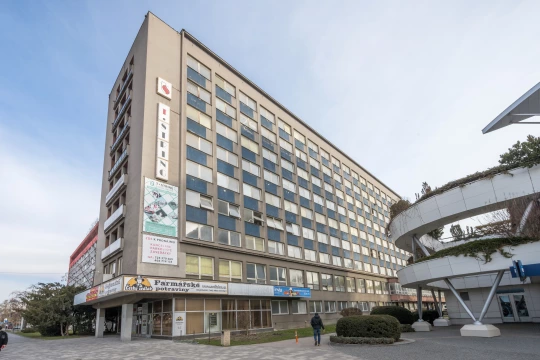
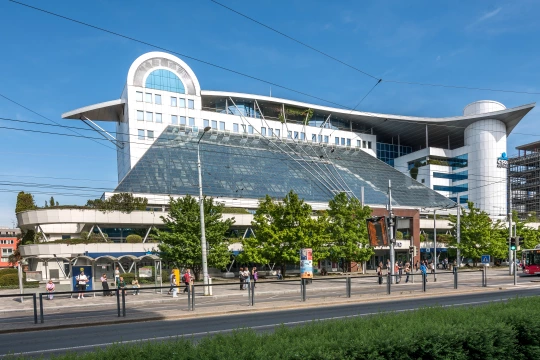
The pinnacle of Crkal’s work in Pardubice occurred in the first half of the 1960s, when he designed significant buildings on Budovatelů Square (today Masaryk Square), which was then emerging as the symbolic center of the new socialist Pardubice. In December 1960, he designed the headquarters of Pozemní stavby Pardubice. In October 1965, he completed the administrative complex adjacent to the headquarters of the Associated Chemical Works. Between 1964 and 1966, dormitories for construction workers designed by Crkal were built in a prominent urban location in Stavařov. For these projects, he received the district architecture award (1968).
In 1968, Karel Crkal sided with the reformists who sought to transform the centrally controlled Stavoprojekt. He called for the organization to be restructured into an “independent association of independent studios.” He was also well aware of the limitations imposed by the central planning of construction. In his view, a perfect architectural work arose from a combination of “progressive science and technology across all areas of our professional fields.” In doing so, he took a direct stand against the very foundations of the stagnant planned economy. During the Normalization vetting process (1970), he was among those professionals who retained their positions, but on the condition that their “political consolidation” would be evaluated at a later date. Subsequently, Crkal’s traces disappear from the sources; by the early 1980s, he was already receiving disability retirement benefits.
Crkal’s completed projects are characterized by consistent quality. The influences of late functionalism are evident in the multi-story parking garages for Višňovka, with their centrally tapering volume. Similar themes resonate in the glass-block windows of the staircase and entrance to the proposed restaurant and single-person housing units in the same housing estate, perhaps inspired by local projects by Karel Řepa. The architect also mastered the use of skeletal systems with great skill. Despite the architecture’s subordination to the given modules, he managed to imbue his buildings with a unique character. He achieved this through the thoughtful use of noble materials (travertine) and systematic work with the roof landscape (outdoor terraces or the “greenhouse”). His work fundamentally shaped the skyline of Pardubice. Nevertheless, Crkal, a passionate cactus collector, is remembered by the general public primarily as the author of the book *The Cactus Hunter* about Albert Vojtěch Frič (1983).
JI
Other Selected Works
Pardubice Civil Engineering Division
Pardubice Gas Construction Division
Unichem Industrial Chemistry Joint Ventures Division
Dormitories in Stavařov
Sources
- SOkA Pardubice, ONV Pardubice, inv. č. 1001, kart. 115.
- SOkA Pardubice, ONV Pardubice, inv.č. 1073, kart. 135.
- SOkA Pardubice, OV KSČ, inv. č. 733, kart. ukl. č. 441.
- Zář 24, 1968, 1. 11..