Glass artist and designer. He worked with pressed, hot-formed and cut glass.
He trained as a glass painter at the Secondary School of Glassmaking in Nový Bor (1951–1953), then studied at the Secondary School of Industrial Glassmaking in Železný Brod (1953–1956), where he became acquainted with the newly emerging field of cast glass, before continuing his studies at the studio of Professor Karel Štipl and Associate Professor Václav Plátek at the Academy of Arts, Architecture and Design in Prague (1962–1967). In 1962, he began working as an artist at the Technical and Design Centre of Sklo Union Teplice, where he remained until 1967, when he moved to the Centre for Arts and Crafts in Škrdlovice. He spent ten years there as a designer, focusing on the small series production of hot-formed glass. From 1977, he worked independently, devoting himself primarily to creating artistically shaped, cut glass in his studio in Žďár nad Sázavou.
Vízner’s minimalist designs for bowls, plates and vases were based on simple forms such as cylinders, spheres, and cuboids. He created perfect geometric shapes from large pieces of glass, giving them their final form using hand tools.
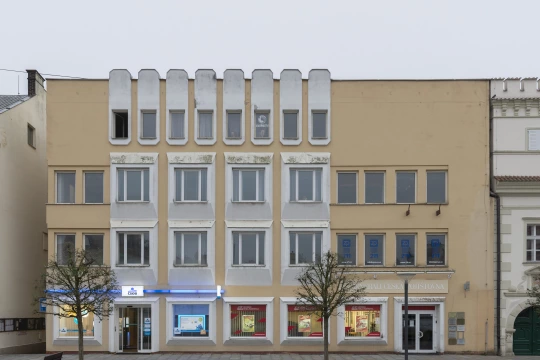
From the early 1970s, he created several remarkable works for architectural projects. These included glass cladding for the Prague metro stations at Karlovo náměstí (1981) and Jinonice (1985); and lighting fixtures for the Prague Congress Centre (1980), the New Stage of the National Theatre (1982), and the Parliament of the Czech Republic (1989). He contributed the artistic decoration to a number of buildings in the form of stained glass, such as the House of Arts in Opava (1974), the cultural centre in Nové Město na Moravě (1975), and the Czech State Savings Bank in Jihlava (1982). In Havlíčkův Brod, he created a glass wall in the meeting room of the Czech State Insurance Company (1983) (HB-1963), which, unfortunately, has not survived to the present day.
He was a member of the Horácko Fine Artists’ Club, and his work is represented in both international collections—such as the Louvre in Paris, the Metropolitan Museum of Art in New York, the Victoria and Albert Museum in London, and the Museum of Modern Art in Sapporo—and in Czech collections, including the National Gallery in Prague, the Museum of Decorative Arts in Prague, and the Moravian Gallery in Brno, as well as in numerous private collections.
Literature
- Monika Hanslová. Sklářství na Horácku. Brno, Ústav hudební vědy FF MU, 2007, Diplomová práce.
- Luboš Hlaváček. František Vízner. In: Anděla Horová (ed.). Nová encyklopedie českého výtvarného umění II, N–Ž. Praha, 1995, p. 908-909.
- Gabriela Petrová. Umělecké sklo Františka Víznera. České Budějovice, JČU, 2013, Diplomová práce.
- František Vízner. In: Horácká galerie v Novém Městě na Moravě. Available from: https://www.horackagalerie.cz/frantisek-vizner [accessed 22. 8. 2025]