Ludvík Lábler came from the family of the Brandýs builder Karel Lábler. He studied civil engineering at the Czech Technical University in Prague and later completed his university education in Vienna. At the beginning of his professional career, he joined architects who preferred historicist styles in their designs and vigorous purism in heritage conservation. As an architect, he made himself known as early as 1880 with his Neo-Romanesque design of a cemetery chapel in his hometown.
However, his most important place of work soon became the town of Kutná Hora, where he was employed at the district building office. He participated in the restoration of many local medieval sights and designed several important public buildings. However, these were not carried out according to his designs, mostly because of the lack of finances. [1] In 1885 he won the competition for the building of the Kutná Hora theatre; later, he designed the local Neo-Renaissance savings bank (1887) and the reconstruction of the Sokol gym (1888) and a hospital with a Neo-Gothic façade (1890). Gradually, he turned his attention to purist modifications of sacred buildings, which he tried to renovate in a supposedly authentic medieval style. However, this kind of heritage conservation sacrificed some of the original architectural features, preserved only in a partial or fragmentary state, and replaced with new elements. In 1884–1906, Lábler participated in the reconstruction of the Church of St. Barbara in Kutná Hora that he took over after the death of Josef Mocker. He designed mainly the interior, including the main altar based on to a period model. The restoration of the Italian Court (1893–1897), the restoration of the Church of the Holy Trinity (1896–1898) and the repair of the Stone House (1900–1902) followed. For his traditional conservation approach, which emphasized the historical appearance of the town, Lábler earned honorary citizenship of Kutná Hora.
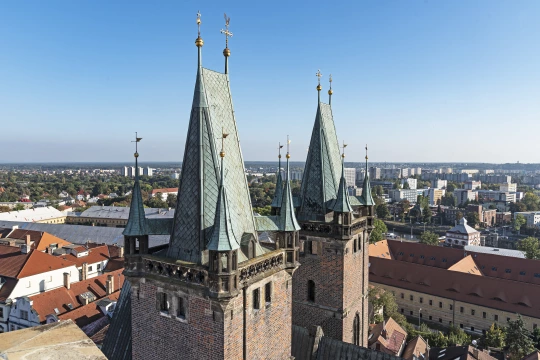
He was also able to use Gothic morphology into new buildings, including churches in Velichov near Karlovy Vary (designed in 1890, built in 1895–1896), in Petrovice near Červené Janovice (1891–1892), and in Bohutín (1892). One of his most prominent designs is the Neo-Romanesque Church of the Assumption of the Virgin Mary (1898–1900) in Kladno. After 1902, Lábler collaborated with Kamil Hilbert on the completion of the St. Vitus Cathedral, and he also restored the gates of the fortifications in Rakovník (1903–1906, together with Eduard Sochor) and the walls in Nymburk (1905–1909). His only project in Hradec Králové was the re-Gothicizing of the Cathedral of the Holy Spirit, designed by František Schmoranz (1901).
After moving to Prague in 1902, Lábler lived in the New Town at 282 Myslíkova Street. He gradually carried out his activities as a court councilor at the governor’s office, and after the establishment of the republic as a ministerial councilor – the head of the building department of the provincial political administration. As a technical advisor, he collaborated, for example, with the administration of Karlštejn Castle or the Czechoslovak Ministry of Foreign Affairs. He died shortly after his 75th birthday and is buried in Kolín, where his wife was from.
MP
Notes:
[1] CÍSAŘOVÁ, Jitka. Architektonická a památkářská činnost Ludvíka Láblera na Kutnohorsku (bachelor’s thesis). Pardubice: Pardubice University – Faculty of Arts, 2009, p. 11.
Literature
- Jitka Císařová. Architektonická a památkářská činnost Ludvíka Láblera na Kutnohorsku (bakalářská práce). Pardubice, Univerzita Pardubice – Fakulta filozofická, 2009.
- Ludvík Lábler. In: Architekt. 1995, roč. 41. sv. 9, p. 2.
- Encyklopedie architektů, stavitelů, zedníků a kameníků v Čechách. Praha, 2004. p. 356–357.
Sources
- Archiv NTM, fond č. 25, Ludvík Lábler, osobní pozůstalost.
Objects of the author
Objects of the author in other architectural manuals