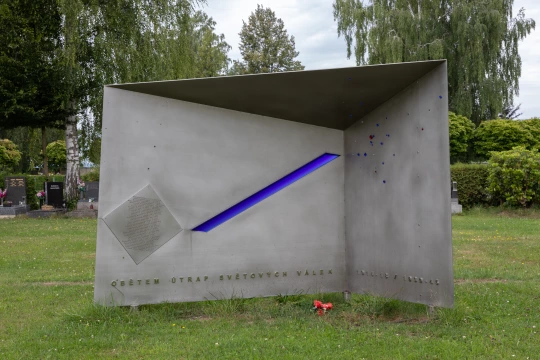
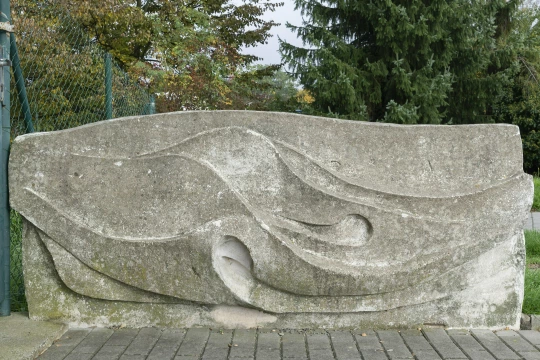
The life and work of sculptor Roman Podrázský illustrate the paradox of pursuing an artistic education and career under a communist totalitarian regime. In some cases, both were possible even for individuals who fundamentally refused to compromise with the regime. The sculptor from Přibyslav, born into the devout family of a private tradesman, was originally not supposed to be allowed to study at all. However, after several attempts, he was eventually admitted—first to the School of Applied Arts in Prague, specializing in mural painting in architecture, and later to the Academy of Fine Arts, where he studied sculpture under Jiří Bradáček and Karel Hladík.
However, being qualified did not guarantee stable artistic employment. The fact that he refused to join the state-controlled Union of Czechoslovak Artists meant he had great difficulty obtaining sculptural commissions. Some of his works were therefore realized under the names of his artist friends. After a brief spell of improvement during the Prague Spring, the situation worsened again with the onset of Normalization, forcing him to leave his home and studio in Prague and return with his family to the Vysočina region.
After 1989, he devoted himself to sculpture all the more intensely. His largest works were dedicated to the memory of the victims of totalitarian oppression—including the Stations of the Cross and paintings in the meditation garden chapel of Luboš Hruška in Doudlevce near Plzeň; the Stations of the Cross commemorating the prisoners of the uranium mines in the Jáchymov, Slavkov and Příbram regions, located by the church in Jáchymov; and the Ecce homo memorial to Father Josef Toufar in Číhošť.
He created a number of works for Přibyslav, where, after the Velvet Revolution, he also served as mayor. In this role, he supported the town museum, archaeological research in urban and suburban areas, local theatre groups and the municipal magazine devoted to history, culture, and ecology. Although his works may not rank among the most artistically prominent, he remains an interesting and admirable figure—one who embodies both Czech and Czechoslovak history and the story of 20th-century art.
Literature
- abArt. Archiv výtvarného umění. Roman Podrázský. Available from: https://cs.isabart.org/.
- Akademický sochař Roman Podrázský. In: Kulturní zařízení města Přibyslav. Available from: https://www.kzmpribyslav.cz/mestske-muzeum-pribyslav/osobnosti-mesta/akademicky-sochar-roman-podrazsky [accessed 5. 9. 2025]
- Vladislava Říhová, Zuzana Křenková. Sochy a města. České umění 50.–80. let 20. století ve veřejném prostoru: evidence, průzkumy a restaurování. In: Sochy a města. Available from: https://sochyamesta.cz/.