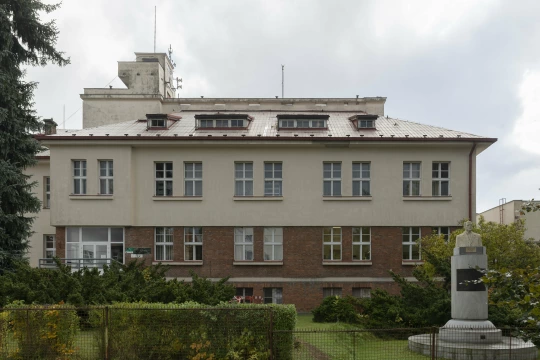
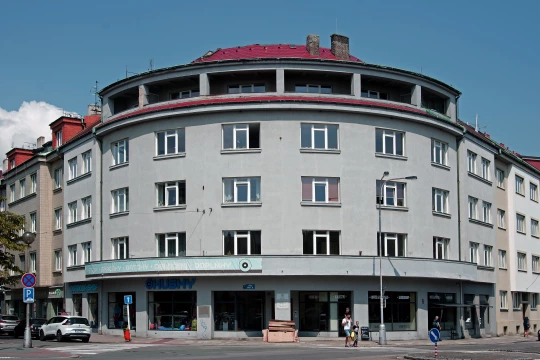
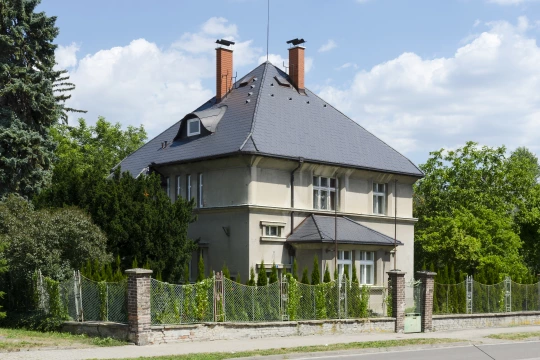
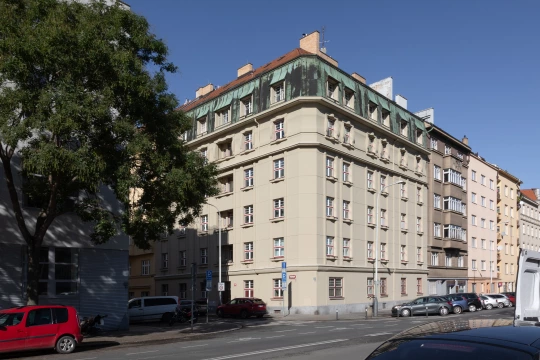
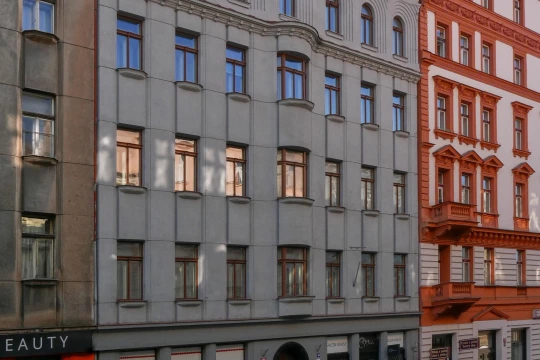
Theodor Petřík was born into a family with an agricultural past, but his father was a doctor. After graduating from a grammar school in Tábor, he studied from civil engineering at the Czech Technical University in Prague in 1908. From his graduation until his death, he worked at the Institute of Civil Engineering at the Czech Technical University in Prague. In 1909, he participated in the competition for the reconstruction of the Old Town Hall in Prague with a surprisingly progressive, but historically sensitive project. The project also became the topic of his dissertation (Význam staroměstského náměstí v regulaci Velké Prahy / The Significance of the Old Town Square in the regulation of the City of Prague). Until 1915, Petřík collaborated with architect Karel Roštík. Together, they built on Petřík’s success (the second prize) in the competition for the Old Town Hall and participated in a similarly significant competition for the Czech theatre in Brno. Although none of the projects was eventually built, the latter competition sparked a debate on modern architecture in Moravia. Together with Roštík, Petřík designed a number of houses and tenement houses and school buildings: the U Kamenného stolu (Stone Table) house in today’s Karlovo náměstí Square in Prague, the villa no. 256 in Prague–Hradčany, a school in Brandýs nad Labem, and the first design of an agricultural school in Hradec Králové. Petřík also designed villa Mr. and Mrs. Novotný’s villa behind the Bechyňská Gate in Tábor with a crystal ornament in the mansard shield and the renovation of the classicist credit union building in Tábor in 1910. After World War I, Petřík began cooperating with his wife and former pupil, the first woman architect in Czechoslovakia, Milada Pavlíková-Petříková. He also designed two observation towers – one near Tábor and another one near Žamberk, both with shingles and cyclopean masonry resembling vernacular architecture. Together with Milada Petříková-Pavlíková, he completed the project of agricultural schools in Hradec Králové–Kukleny and the adjacent campus, including the main cubist school building, training stables, and silos. Petřík also designed a school farm of the University of Agricultural and Forestry Engineering in Uhříněves. At the turn of the 1920s and 1930s, he worked on the construction of the campus of the Czech Technical University in Prague–Dejvice, where he used monumental forms and baroque floor plan layouts. In the 1920s and 1930s, Petřík also designed villas for Bedřich Honzák in Hradec Králové, Stanislav Zeman in Šlapanice, Vladimír Petřík in Prague, and a villa in Horní Roveň. All the projects developed a moderate cubist and classicist morphology and updated the principles, materials and forms of traditional vernacular and architecture: the porch, cyclopean masonry, wooden elements, gambrel roof, traditional pediment, etc. Petřík’s most important contribution to interwar architecture was his theoretical research of agricultural architecture and its modernization. He could also test his results in practice: he designed a pig farm in Voděrady (1920), a complex of the National Potato Research Institute in Německý Brod (1926–1929), manor farm estates in the Mladá Boleslav region, and a stud farm in Topolčianky (now Slovakia). He contributed to Czech modern architecture with his purposeful and convincing research of sanitation and rationalization of agricultural buildings and its application in the development of quite modern architecture, combining the principles of geometric and purist modernism and traditional, almost archetypal rural forms and architectural techniques.
LZL
Literature
- Theodor Petřík. 1909, VIII., p. 1.
- Theodor Petřík. 1922, III., p. 117–160.
- Theodor Petřík. 1941, p. 226–236.
- Encyklopedie architektů, stavitelů, zedníků a kameníků v Čechách. Praha, 2004. p. 347–348.
- Ladislav Zikmund-Lender. Josefov, 2013, p. 37–44.
- Martin Zubík. Slavné stavby Theodora Petříka. Praha, 2014.
- Ladislav Zikmund-Lender. Struktura města v zeleni: Moderní architektura v Hradci Králové (TP). Hradec Králové, 2017, p. 129–140.
Sources
- Martin Zubík, Prof. Dr. Theodor Petřík (1882-1941) a jeho význam v české architektuře první poloviny 20. století, diplomová práce, Filozofická fakulta Univerzity Jana Evangelisty Purkyně Ústí nad Labem, 2009.