The son of engineer and builder Josef Šupich. Engineer, architect, and builder, owner of the Josef Šupich construction company, and mayor of Německý Brod.
He graduated from the grammar school in Německý Brod and then studied civil engineering at the Czech Technical University in Prague from 1888 to 1890. He continued his studies at the Vienna Academy under Professor Otto Wagner and passed his state examination in Prague in 1897.
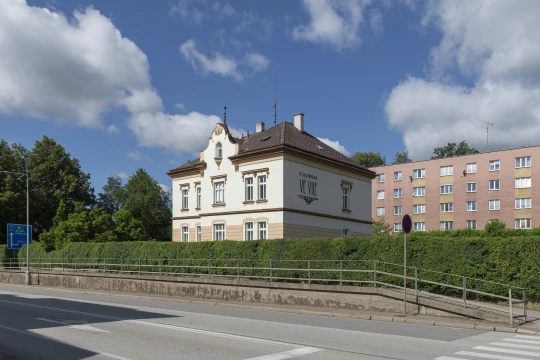
His expressive repertoire was varied and changed over the years. His first projects were in the historicist style, but he designed his own villa in 1909 with Art Nouveau motifs on the facade, and in the interwar period he leaned towards the Neoclassical style.
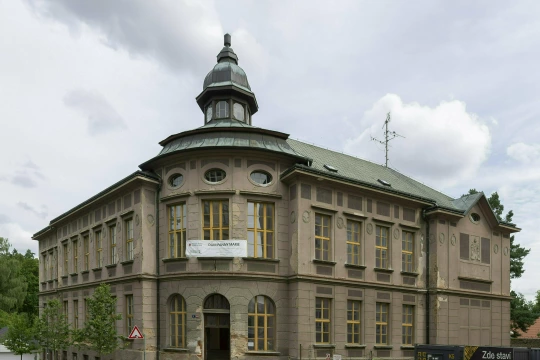
After returning to Brod, he worked in his father’s construction company, which he took over in 1910 and expanded with a new brickworks. Although the company lost its privileged position in the town at the beginning of the 20th century, he managed to obtain and implement a number of important contracts based on his own and other people’s designs, such as the reconstruction of the New Town Hall (1912–1913) (HB-57), the construction of the Czechoslovak Church congregation hall (1926–1927) (HB-2014), and the administrative building of the Provincial Institute for the Mentally Ill (1927) (HB-2322). In addition, Prokop Šupich had several villas to his credit and also made a name for himself in Prague, where a Neoclassical apartment building was built in Hradčany (Tychonova 44/3) according to his design in 1929. Between 1922 and 1926, when he served as mayor of Německý Brod, he interrupted his design and construction work. He then ran the family business until his death in 1947. He did not live to see its nationalization.
Literature
- Pavel Vlček. Prokop Šupich. In: Pavel Vlček, Pavel Zahradník a kolektiv. Encyklopedie architektů, stavitelů, zedníků a kameníků v Čechách, 2. rozšířené vydání. Praha, 2023, p. 908.
- Michal Kamp. Firma Josef Šupich. In: Havlíčkobrodsko. Havlíčkův Brod, 2009, roč. 23, p. 120-164.