Zdeněk Strnadel was born in Ostrava into the family of a locksmith, Metoděj Strnadel, and his wife Anna, née Mohylová. His father was associated with the Communist Party of the time, maintained contacts with Klement Gottwald, and was probably among the founding members of the Communist Party of Czechoslovakia.
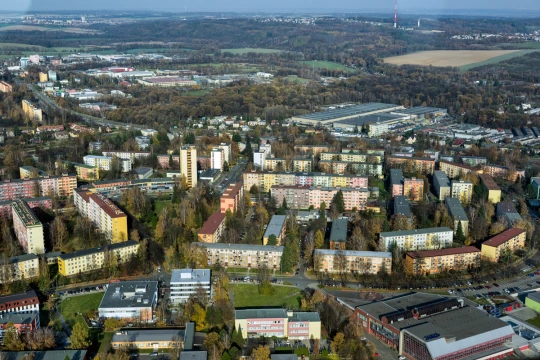
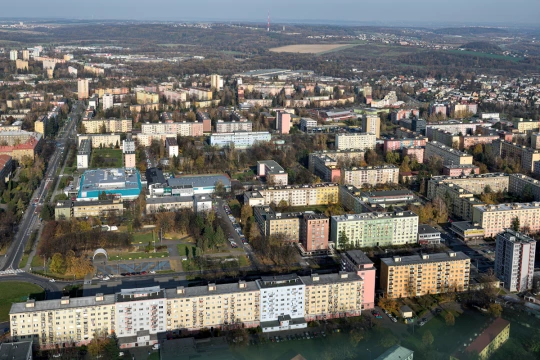
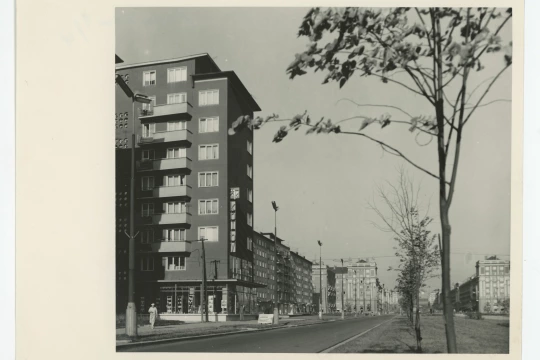
After completing his secondary education in 1940, Strnadel was conscripted for forced labour in Germany. During this period, he strengthened his left-wing orientation and commitment to communist ideology. In 1947 he began studying at the Faculty of Architecture and Civil Engineering of the Technical University in Brno. Ostrava communists supported his studies with the expectation that he would promote communist ideas among university students in Brno. After 1948 Strnadel served as a student representative on political screening commissions. He completed his studies in 1950 and returned to Ostrava. He began working at the regional design institute Stavoprojekt, and in 1951 became chairman of the enterprise committee of the Communist Party. In 1952 he was appointed to the leadership of the Regional Design Institute in Prague, where he remained until 1955, when he was dismissed from the post. He subsequently returned to Stavoprojekt in Ostrava, where he participated in the design of residential buildings for the newly developing district of Poruba.
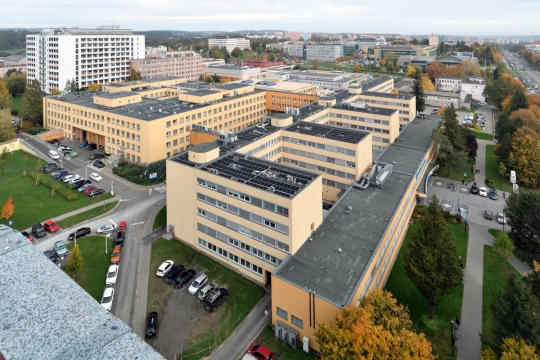
Between 1959 and 1960 Studio 6 was established within the Ostrava branch of Stavoprojekt, specialising in healthcare and educational buildings. Strnadel became its chief architect. Through his initiative – and partly thanks to his political engagement – the studio obtained commissions for the large planned campuses of the Mining University and the hospital with polyclinic in Poruba. Both projects were developed over a long period by large teams of architects, and it can be assumed that Strnadel’s role as head architect was primarily managerial and decision-making rather than purely creative. After 1968 he became involved in the political processes of the period of “normalisation” and in 1972 was appointed chairman of the Union of Architects, from which architects who opposed the political situation after 1968 were expelled.
In addition to leading Studio 6 in Ostrava and his political work within the Union of Architects, Strnadel began teaching in 1974 as an external lecturer at the Faculty of Architecture of the Technical University in Brno. In 1981 he was appointed professor, left Stavoprojekt in Ostrava, and took up a full-time academic position in Brno. After the political changes of 1989 he spent the final years of his life in Prague. He remained faithful to communist ideals until the end of his life.
Výběr z dalšího díla
Completed projects:
Within Stavoprojekt – Studio 6 for educational and healthcare buildings, headed by Zdeněk Strnadel (until 1982)
Technical project for the first phase of the campus of the Mining University, Ostrava-Poruba, 1967 (with Milena Vitoulová, Zdeněk Kupka, Vladimír Svoboda, Vincenc Vorel, Miroslav Holek, Josef Kellner, and Zdeněk Šťastný)
Completed projects outside Ostrava:
Within Stavoprojekt – Studio 6 for educational and healthcare buildings, headed by Zdeněk Strnadel (until 1984) and Zdeněk Kupka (1984–1991)
study for a healthcare school, Karviná, 1972 (with Evžen Kuba; construction project 1974)
study, project documentation, and architectural supervision for a polyclinic, Bruntál, 1974–1981
project documentation and architectural supervision for a polyclinic, Kopřivnice, 1976–1983 (with Zdeněk Kupka, study phase)
study for a polyclinic, Karviná 8, 1976–1983 (with Tomáš Kučera; construction project and architectural supervision)
study, project documentation, and architectural supervision for a rehabilitation pool, Rehabilitation Sanatorium Karviná, today Darkov Spa – Rehabilitation Sanatorium, 1976–1989
study for the complex of the State Spa in Klimkovice (today Sanatorium Klimkovice), 1986; the project was subsequently transferred to Stavoprojekt Opava (Jiří Macháček) and completed in the early 1990s (Vladimír Gleich)
initial project for the balneotherapy building, Rehabilitation Sanatorium (today Darkov Spa – Rehabilitation Sanatorium), 1987–1988
master plans for hospitals in Bruntál, Rýmařov, and Vsetín, 1986–1990
study for the reconstruction of the treatment and diagnostic building within the hospital complex in Čeladná, 1991 (with Ladislav Vitoul)
Literature
- BERÁNEK, Matěj; ERBANOVÁ, Eva; GUZIK, Hubert; CHATRNÝ, Jindřich; KRACÍK, Matyáš et al., 518, Vladimir (ed.).. Architektura 58-89. Praha, Big Boss, 2022. Zdeněk Strnadel, s. 245-261.